
Finding the Liminal

Originally published in Unknown Quantities Journal, issue 12.
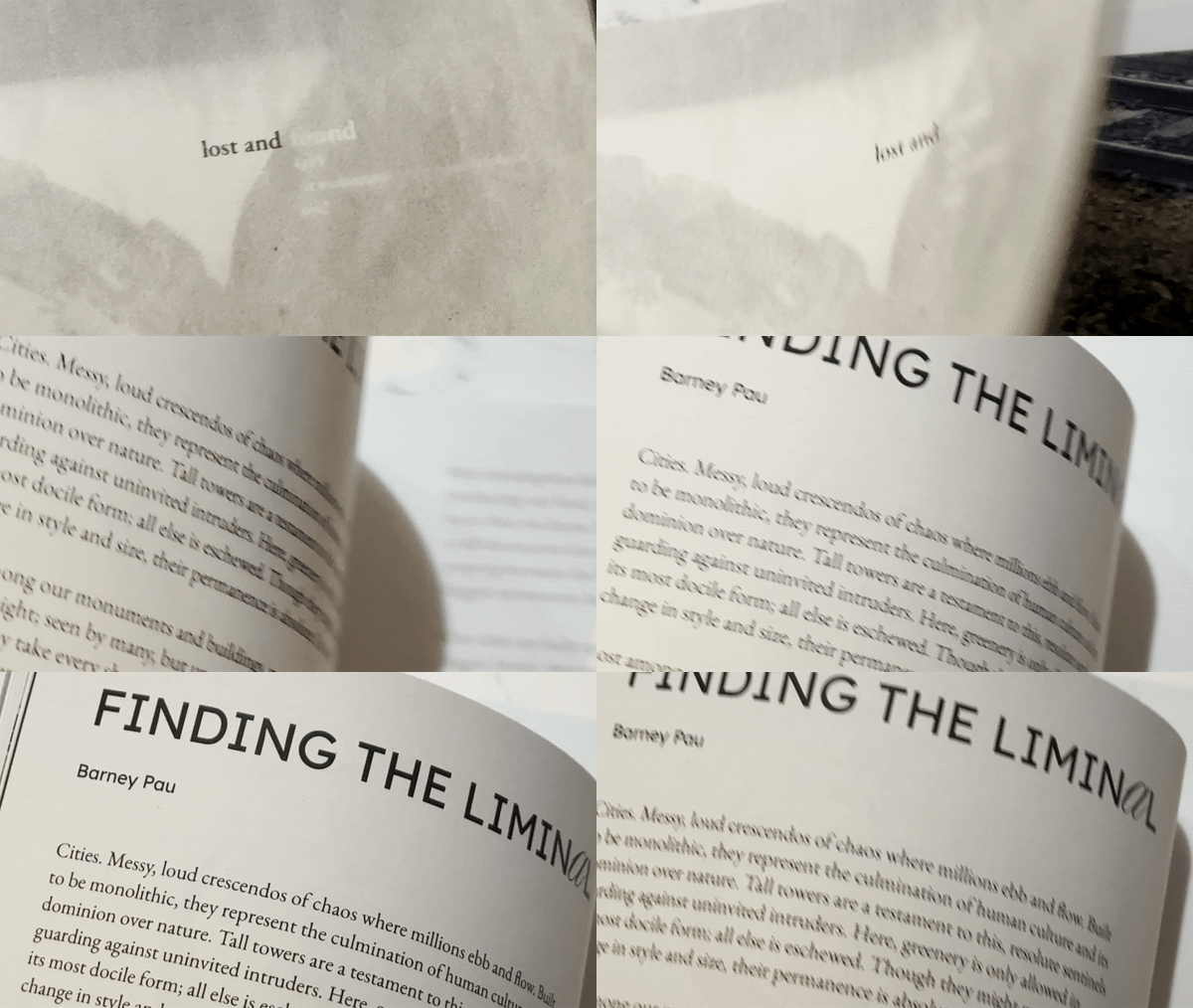
Cities. Messy, loud crescendoes of chaos where millions ebb and flow. Built to be monolithic, they represent the culmination of human culture and its dominion over nature. Tall towers are a testament to this, resolute sentinels guarding against uninvited intruders. Here, greenery is only allowed in its most docile form; all else is eschewed. Though they might morph and change in style and size, their permanence is absolute. Or is it?
Lost amongst our monuments and buildings, myriad minute ecologies thrive in plain sight; seen by many, but unnoticed by most. From the micro to the macro they take every shape and size, squeezed into the city’s most unexpected corners. Here, they exist in transient states of perpetual uncertainty, for each day could end in a spray of glyphosate, or the tug of a gloved hand. So they’re found in spots that we’ve forgotten, for remaining lost ensures their longevity.
Firmly rooted between nature and culture, the liminal ecology does more than just grow in the grey. It bridges the divide drawn by our dualism, reuniting the human and more-than-human in a messy multi-species amalgam. Beyond the physical, it becomes a metaphor of resistance, paralleled with other forms of non-normative existence.12 Its feelers creep into crannies and slide through slivers, forming city-wide revolutionary networks of self-seeded greenery.
A bold claim to make for a collection of pollution-muted plants growing amongst the brightly coloured rubbish. Yet even in the tenderest of their tendrils, one can find resilience. Their tips—so soft to the touch—can raze foundations, breaking through the toughest materials. Alone, they have little impact on our cities. Left to their own endeavours, they could well raze our foundations sooner than we’d like to think. United, they become a radical force against our deeply ingrained growthism.
Growthism, also called productivism, is the belief that progress is essential to human purpose.3 We can see this on an international scale through transcontinental trade and manufacturing. Yet it also trickles down into the core tenets of our self-identity. We believe that we must progress to be successful. Stasis or regress are thus posited as failure in their opposition to growthism’s supposed success.
On a societal level, in this country certainly, many of our core value systems are built upon growthism. This isn't necessarily on us, though. Well, not all of it, anyway. We’ve been taught to consume, while having the true cost of that consumption hidden from us. Yet the ecological and social cost of producing our food, mining our metals, or growing our clothes harms us more than we know. In this light, growthism’s drive for progress becomes a self-destructive force, taking us down with it. So when a liminal ecology pops up between the bricks I rejoice. It might only be small, but even the biggest movements began at a grassroots level.
Our cities are built upon the notion of growthism. Progressively newer, bigger, better; they exist under the imperative to prioritise human endeavour over all else. As such, they’re designed to be ecologically barren, playing host to only the most domesticated of non-human species. Against this framework, the liminal ecology is a generative force, one full of infinite potential and diversity. It can exist wherever, and thrive where nothing else will.

More often than not the lost liminal ecology is filled with species we call ‘weeds:’4 plants defined by growing where we want them not to. Weeds have been diligently regreening our cities for centuries, repairing the landscapes we destroy and building on the ones we create. In the chaos of our destruction, their remediation shines green against the grey. What injustice then, that even as they repair our mess we find such ire for them.
This disdain is unanimous. In Spanish, there’s a saying that Hierba mala nunca muere, ‘weeds never die’. It’s a colloquialism suggesting bad people/things last longer than good. Beneath this use, though, it could suggests the resilience needed for a life led outside the law. Most people would call this criminal, but law is a fickle thing. Aside from the absolutes—don’t kill, steal, rape, etc.—many laws are designed to suppress. It’s not so long since so-called ‘buggery’ was a crime. Rather than snide, then, perhaps this idiom is endearing, commending resistance against repression. Long live las malas hierbas.
Spanish is an interesting lens through which to understand weeds. There is no specific name for them, they are just called malas hierbas, ‘bad herbs.’ This isn’t so much to do with them being ‘bad’ for us; many weeds’ medicinal and nutritional properties abound. Instead, the Spanish definition aligns with its English counterpart, of a plant which is in the wrong place: defining them by their perceived lack of value.
At the start of this article, I suggested how, by being able to ‘exist wherever’ in the city, the liminal ecology bridges the divide drawn by our dualism. To elaborate, dualism is a notional division between human and more-than-human existences. The original concept was coined by philosopher René Descartes who understood physical functions as separate from mental processing.5
Descartes was not alone in his dualistic thinking. From philosopher Immanuel Kant’s delineation between human sentience and non-human instinctiveness;6 to the Abrahamic notion of the world as a human resource: we have a long history of prioritising ourselves. Indeed, its not hard to see where this superiority complex might have found its genesis, for as is writ in Genesis “everything that lives and moves about will be food for you. Just as I gave you the green plants, I now give you everything.”7
The Abrahamic religions took this as gospel and placed humans atop a vast hierarchy, under which all other organisms were then arranged. Cue humanity’s wanton environmental destruction in search of every extractable so-called ‘resource’ we can find.
So… how does the grimy liminal ecology have anything to do with dusty medieval-cum-biblical notions of dualism? Well, I may believe Kant’s dualism misguided, but his other philosophising rang true “Look closely. The beautiful may be small.”8 If the permanence of our monolithic structures represents the pinnacle of our species’ dominance of nature, then the small, forgotten liminal spaces in between them represent the antithesis. In their growth, they deny growthism.

That which is not controlled represents a threat to the controller. As such, I find these ecologies to be fertile ground in which to seed alternative thought and social metaphors. The liminal ecology has always opposed what growthism values. Growing in the wrong place, it resists what we hold of ‘worth’. This is perhaps what I find to be its valuable trait.
It is bold to label the liminal ecology as resistant. In fact, it verges on hubris. In all our busyness, we forget that we’re but a blip on planetary timelines, despite all our earth-changing impacts. As professor Alan Weisman writes in The World Without Us (2007), “without us, Earth will abide and endure; without her, however, we could not even be.”9 It’s thus important to recognise that my sentiments are an entirely human projection, for the liminal ecology just grows where it’s seeded. It has no say in my interpretation of it; just as it exists unbound by any notions I may have. Its growth isn’t actually resistance, it’s simply existence.
Yet any agency it may have has been bulldozed by human bias, so to exist it must resist. This is my personal opinion, rooted in my affinity with the liminal ecology and its weeds. I resonate with its existence. Note: I do not see myself as without value, or being in the wrong place. Far from it. I see myself in opposition to those who tell me I am in what they perceive to be the wrong place. I am far from lost.
Where I do lose myself is in the liminal ecology, for here I find I am at peace. I wonder whence the seeds came; how one species interacts with one another. I walk the street peering at forgotten corners, seeing which weeds might thrive where. It has shown me how to find beauty and balance in the countless existences around me, happy to walk quite lost in my own thought.
To lose oneself is to become deeply involved in something. So much so that all our attention and thoughts are engaged. This often takes place outside the physical realm; in a task, passion, or process which consumes us. So let’s lose ourselves in the liminal and find inspiration there, for in these ecologies lie embodied knowledge of how to thrive in the face of adversity. By becoming utterly rapt, we might pause growthism, and lose ourselves in the growth of other species, for they’re the ones who can help us find the connection with nature again.
‘Between the Cracks’, Barney Pau. (07.06.2024). MOLD Magazine. [https://thisismold.com/series/queering-theory/between-the-cracks]. Accessed 19/09/24.
‘Weeds and their Metaphors’, Barney Pau. (06.09.2023). It’s Freeezing in LA!. [https://itsfreezinginla.com/articles/weeds]. Accessed 19/09/24.
‘Growthism: its Ecological, Economic and Ethical Limits’, Herman Daly. (28.03.19). Local Futures. [https://localfutures.org/growthism-its-ecological-economic-and-ethical-limits/] Accessed 25/09/24.
‘Weed’, OED. (2024). The Oxford English Dictionary. [https://www.oed.com/search/dictionary/?scope=Entries&q=weed]. Accessed 23/09/24.
33. Thomas, K. (1983). Man and the Natural World: Changing attitudes in England 1500-1800. London: Penguin Books.
1.3. Tam, Agnes and Margaret Meek Lange, ‘Progress’, The Stanford Encyclopedia of Philosophy (Spring 2024 Edition), Edward N. Zalta & Uri Nodelman (eds.), [https://plato.stanford.edu/archives/spr2024/entries/progress/].
(Genesis, 9:3)
No ref. available
287. Weisman, A. (2007). The World Without Us. London: Virgin Books.